

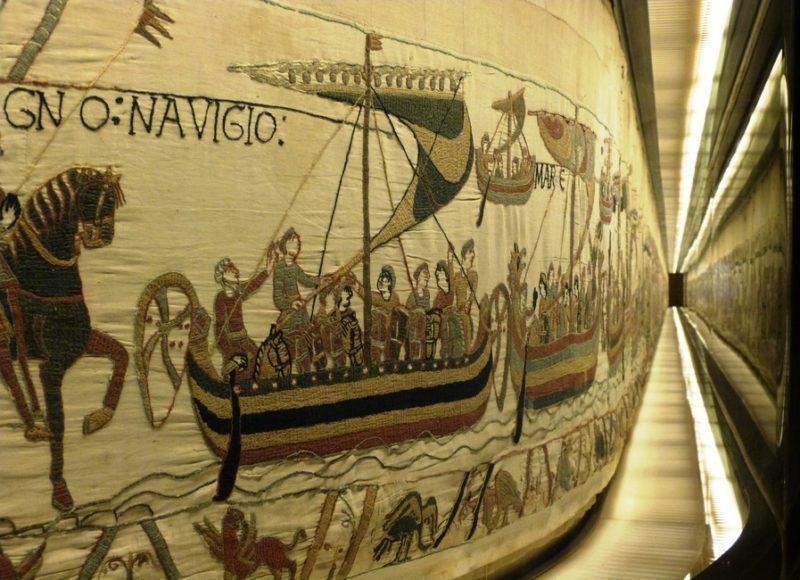
Art throughout history has vividly depicted conflicts, with pieces such as Picasso’s “Guernica” and Goya’s “The Disasters of War.” One of the most ancient and striking representations is the renowned Bayeux Tapestry from 11th-century France. This embroidered masterpiece, over 70 meters long and 70 centimeters high, narrates the 1066 Norman conquest of England—the last successful invasion of the country by a foreign power led by William, Duke of Normandy, later known as William the Conqueror.
The artists behind the tapestry have been lost to history, but it is believed to have been commissioned by Odo, the Bishop of Bayeux and William’s half-brother, to adorn the nave of Bayeux’s Notre-Dame Cathedral, consecrated in 1077. Since 1983, the tapestry has been displayed at the Grand Seminary in Bayeux, in northwestern France, as part of the city’s museum complex, which also houses the Memorial of the Battle of Normandy and the Baron Gerard Museum of Art and History.
However, those wishing to view this iconic piece of art propaganda should hurry: the museum will close at 7 PM (local time) on August 31, 2025, for extensive renovations and restoration, with a reopening scheduled for October 2027, coinciding with the 1,000th anniversary of William the Conqueror’s birth.
The renovation project, spearheaded by the British architectural firm RSHP, will include a new wing at the Grand Seminary, doubling the exhibition space for the tapestry. With a budget of 38 million euros (approximately $226.5 million), the renovation is being managed by the City of Bayeux in partnership with the French State—which owns the tapestry—as well as the Calvados Departmental Council and the Normandy Regional Council. “In terms of economic and cultural impact, this is the most complex and ambitious project ever undertaken by the City of Bayeux,” stated Mayor Patrick Gomont in a press release.
As before, the tapestry will be housed in a hermetically sealed room to protect it from variations in light, climate, and air pollution. It will now be displayed on an inclined support, specially designed to ensure the preservation of this delicate fabric, now almost a thousand years old. In 2024, nearly 600,000 visitors passed through Bayeux’s museums, with the majority of international tourists coming from the United Kingdom and the United States.
In its creation period, during the 11th century, the tapestry served as a storytelling medium for a predominantly illiterate audience, combining imagery and textual inscriptions. The most famous scene depicts Anglo-Saxon King Harold, the last King of England before the Norman conquest, struck by an arrow in the eye at the Battle of Hastings. Another significant element is the depiction of Halley’s Comet, six centuries before the English astronomer Edmond Halley would name it.
Preserving this millennia-old artifact requires more than just washing it at the right temperature. “During periods when the museum is closed to the public, the exhibition structure can be moved within the building, turning it into a true laboratory,” explained Antoine Verney, chief curator of Bayeux Museums, in a statement. This will allow for detailed photography, continuous monitoring, and in-depth studies, along with an ambitious restoration plan led by the French State to stabilize the embroidered fabric’s damages.
Despite being almost a thousand years old, the original colors have remained surprisingly vivid. However, restorations carried out in the 19th century, especially in the final sections of the piece, have faded significantly.
The disassembly and restoration process began in January 2025, involving a careful cleaning of the linen and removal of a wool backing added in 1983. In autumn 2025, the tapestry will be removed from its display case, packed in a conservation box, and moved to a temporary location. It won’t be the only major French attraction undergoing renovations. The Pompidou Center in Paris—famous for its innovative 1970s architecture with exposed piping—will also close, but for a longer period: five years, starting in the second half of 2025.

